


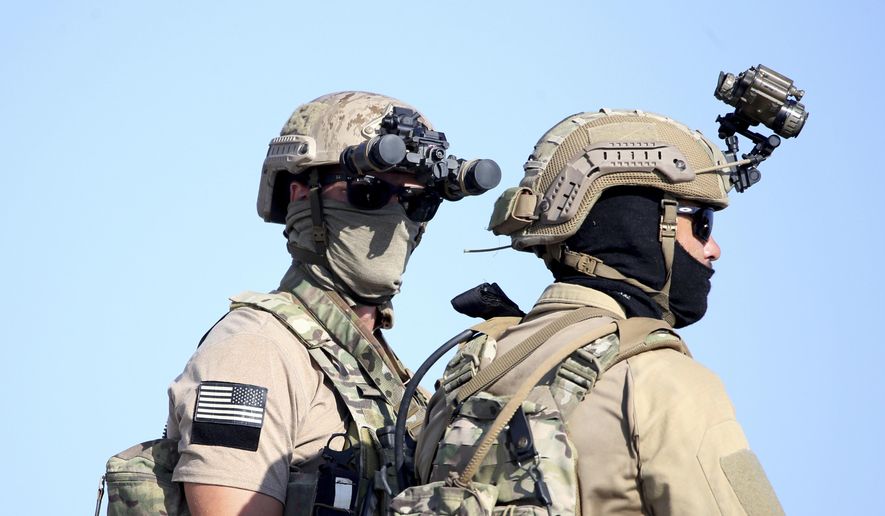

Modern warfare carries an “insatiable” demand for the complex, dangerous missions that only America’s special operations forces can execute, such as the daring January raid to capture Venezuelan President Nicolas Maduro from a heavily guarded compound in a foreign capital.
Yet key lawmakers and military insiders say the Pentagon’s increasing reliance on special operations forces — elite units such as the Green Berets, Navy SEALs and Delta Force — has not been adequately matched in the military’s ballooning budget.
Although the Pentagon is eyeing a 44% overall budget increase to $1.5 trillion in fiscal year 2027, the top-line budget for U.S. Special Operations Command operations and maintenance would rise much more modestly, from $9.7 billion in discretionary spending this fiscal year to $10.9 billion in 2027.
Those figures do not include funding for procurement, research and development, and other costs associated with Special Operations Command, so the full financial picture is more complicated.
Regardless, some prominent military analysts argue that a deep, underlying disconnect exists between the rapidly changing nature of 21st-century combat and the relatively light investment in the select, unconventional units tasked with America’s most difficult and sensitive military missions.
“We’re in a transitional phase, but we’re not really adapting fast enough. Everybody talks about it and writes papers about it. But then you look at the defense budget, and it’s the same stuff all over again,” said Stu Bradin, president and CEO of the Global SOF Foundation, which co-hosts the annual SOF Week convention in Tampa, Florida, with U.S. Special Operations Command. The event is the country’s largest gathering of special operations forces personnel and defense contractors from around the world.
Mr. Bradin and other advocates of special operations forces contend that today’s battlefields do not allow for the traditional massing of ground troops or tanks. Traditional maritime assets such as aircraft carriers and their associated carrier strike groups could be more vulnerable today to drone swarms or other new attack methods.
In the new reality, Mr. Bradin said, elite military units become even more important than they have been in years past.
“I think it’s all irregular warfare,” he told The Washington Times, referring to today’s and future combat. “Look at our own country. Nobody wants to fight a war with conventional forces. How long does it take to get a conventional force into a conflict area? And what happens to it? It gets attrited quickly. What politician, policymaker or leader wants that?”
A new calculus in combat
The war in the Middle East may have provided an example of that evolving calculation.
In early April, President Trump reportedly considered sending Army and Marine Corps personnel ashore in Iran to secure key military and energy infrastructure sites and potentially begin the difficult mission of finding and removing Iran’s highly enriched uranium stockpiles.
Those troops were ultimately not dispatched to Iranian soil. Sources told The Times that one key reason may have been higher-than-expected casualty projections, potentially because of U.S. troops’ vulnerability to Iranian drone attacks.
Leading military analysts sounded the alarm that some American military units simply were not ready to deal with swarms of Iranian Shahed drones attacking them in large numbers.
“If they’ve got 100 Shaheds coming at them, how are they going to deal with that?” Jim Townsend, a former deputy assistant secretary of defense for European and NATO policy, told The Times at the time.
“If they let 10 of them through, it will cause mass casualties. It’s a disaster waiting to happen,” said Mr. Townsend, now an adjunct senior fellow at the Center for a New American Security.
By contrast, the mission to capture Mr. Maduro involved many traditional military assets, and the on-the-ground operation in Caracas concluded within hours and was carried out by the most elite special operations forces units in the U.S. military.
Several U.S. service members were reportedly injured during that operation, but none was killed.
That mission is considered perhaps the largest and most complex special operations forces mission in American history. Its success reinforced the belief that those specialized forces will be at the center of U.S. power projection for decades in all corners of the world, including the strategically vital Indo-Pacific region.
Special operations forces are expected to play a central role in broader U.S. military and geopolitical strategy moving forward. Although elite special forces units became virtual household names during the war on terror, with high-profile missions such as the 2011 raid in Pakistan that killed al Qaeda leader Osama bin Laden, analysts are quick to point out that special operations forces’ roots are much wider.
Dating back to the most dangerous periods of the Cold War, those personnel were often on the front lines of the American fight against communist forces, working on the ground with resistance forces and undertaking specialized missions around the globe, including evacuation and counterguerrilla operations to combat Soviet influence.
Budget versus reality
Few dispute the importance of special operations forces in today’s environment, but powerful lawmakers say the Trump administration’s proposed Pentagon budget, like years of budget proposals before it, simply does not make the investments needed.
“Special operations forces conduct direct action against high-value targets. … They train and advise partner forces, building capacity and strengthening alliances across Latin America, Europe and the First Island Chain,” Sen. Roger F. Wicker, Mississippi Republican and chairman of the Senate Armed Services Committee, said at an April 28 hearing. “They gather intelligence against our adversaries in hostile environments. They respond to crises worldwide at a moment’s notice. And they operate in the gray zone between peace and war, the context in which much of today’s strategic competition unfolds.
“However, the funding provided to Special Operations Command has not kept pace with the seemingly insatiable demand for its capabilities. The command faces a troubling gap between its mission requirements and available resources,” Mr. Wicker said, referring to Pentagon budgets.
The nonprofit Global SOF Foundation is pushing for a more than 100% increase in Special Operations Command’s top-line budget, which oversees all special operations forces across various military branches. The foundation wants a $24 billion top-line budget, compared with the $10.9 billion called for in the Trump administration’s fiscal 2027 spending plan.
Special operations forces commanders testified Tuesday before the Senate Armed Services subcommittee on emerging threats, highlighting the specific capabilities their units provide and why they need more financial resources.
“Events of the past four months alone demonstrate the demand for special operations forces has not abated; our formations remain fully employed, providing special operations options in pursuit of our nation’s priorities in every geographic combatant command and across the conflict continuum,” Lt. Gen. Lawrence G. Ferguson, commanding general of the Army’s Special Operations Command, told the subcommittee.
Contact the author


Please read our comment policy before commenting.